

Fabrics & Fibres
What Cashmere Is and Where It Comes From
Published on 09/05/2026
Are Cashmere and Cachemira the Same Thing?
Cashmere and cachemira are a frequent source of confusion. The difference between them is purely linguistic — one name in English, one in Spanish — and implies no distinction at all in the properties, the origin or the quality of the cloth.
Both terms come from the region of Kashmir, in the north of the Indian subcontinent. In international trade, “cashmere” is the more widespread term.
What Is Cashmere, and Where Does It Come From?
Cashmere is a natural fibre taken from the undercoat of the cashmere goat (Capra hircus), adapted to high-mountain climates in Kashmir, Mongolia, China and Iran. To survive winters of down to −40 °C, these goats grow an undercoat of extraordinarily fine fibre — between 13 and 19 microns in diameter — gathered once a year by hand-combing.
Each animal produces between 150 and 200 grams of usable fibre per season. Mongolia and the Inner Mongolia region of China are today the largest producers by volume.

What Is the Difference Between Cashmere and Sheep’s Wool?
| Characteristic | Cashmere | Sheep’s wool |
|---|---|---|
| Animal | Cashmere goat (Capra hircus) | Sheep (various breeds) |
| Fibre diameter | 13–19 microns | 17–24 microns (merino); coarser in other breeds |
| Softness | Exceptional | Variable — merino: high; standard: medium |
| Lightness | Very high — 6 to 8 times lighter | Heavier for its volume |
| Durability | Moderate — needs particular care | High — stands up better to daily use |
| Production volume | Limited — 150–200 g per animal per year | Abundant |
Merino wool is the sheep’s wool closest to cashmere in quality, but cashmere fibre remains finer, lighter and softer to the touch. A pure cashmere blanket gives warmth at a significantly lower thickness and weight than the equivalent blanket in merino wool.
What Determines the Quality of Cashmere?
Not all cashmere is of the same quality. Three factors are decisive:
- Fibre diameter. High-quality cashmere sits between 14 and 16 microns. Above 19 microns the cloth can feel less soft against the skin.
- Yarn length. Longer fibres produce stronger yarns and cloth with less tendency to matting; they hold their shape and their appearance better with use.
- Spinning and finishing. The twist of the yarn and the surface finish determine the final sensation and the way the piece behaves in the wash.
Cashmere in Home Textiles and Hospitality
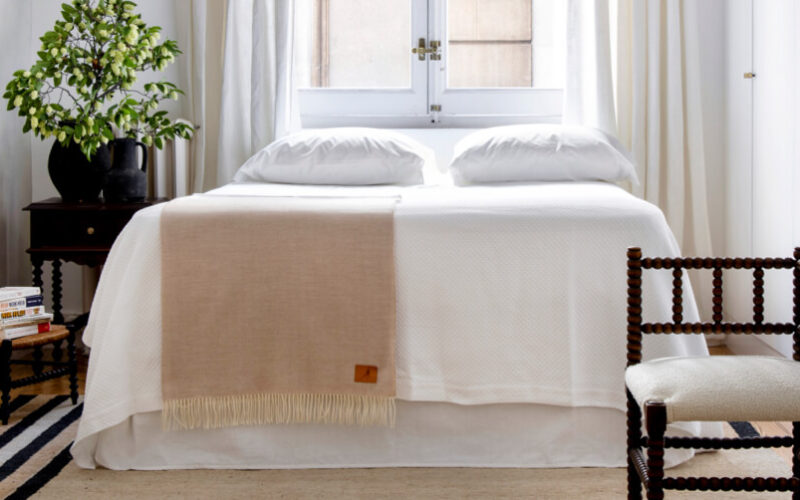
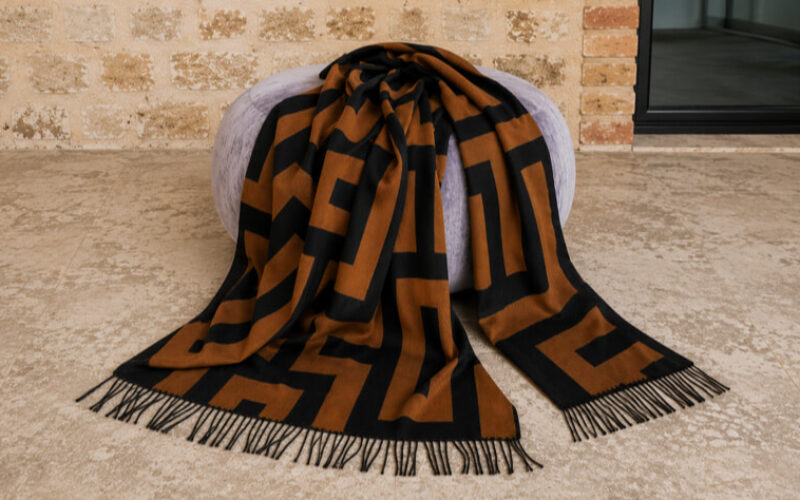
Cashmere is used in bed linen for hospitality and in high-quality blankets, pure or blended with other fine fibres. Its principal advantage is warmth at minimum thickness: it gives heat equivalent to wool at a significantly lower weight and bulk. It is the usual choice in bedspreads and seasonal blankets where thermal comfort and handle are the priorities. In high-end hospitality it is used in suites and rooms where the quality of the cloth is part of what the guest experiences.
The Matarranz blanket catalogue is available in our online shop.

Frequently Asked Questions About Cashmere
Why is cashmere so exclusive?
Because the raw material is scarce and the process is done by hand. Each cashmere goat produces 150 to 200 grams of usable fibre a year; the gathering is manual and seasonal.
Is cashmere warmer than wool?
It warms comparably to high-quality merino wool, but at far less thickness and weight. The cashmere fibre has a hollow structure that retains heat efficiently.
How should cashmere be washed?
Hand wash in cold water, or a delicate cycle at 30 °C maximum, with a neutral detergent made for delicate fibres. Do not wring or squeeze hard. Dry flat on a horizontal surface: never in a tumble dryer, never hung.
How do you identify genuinely good cashmere?
Four indicators: 100% cashmere on the composition label, immediate softness to the touch without needing to be washed first, light weight, and verifiable traceability from the manufacturer on the origin and the grading of the fibre.