Style & Inspiration
How to Dress a Bed: Layers, Finishes and the Style of a Well-Composed Bedroom
Published on 08/10/2026
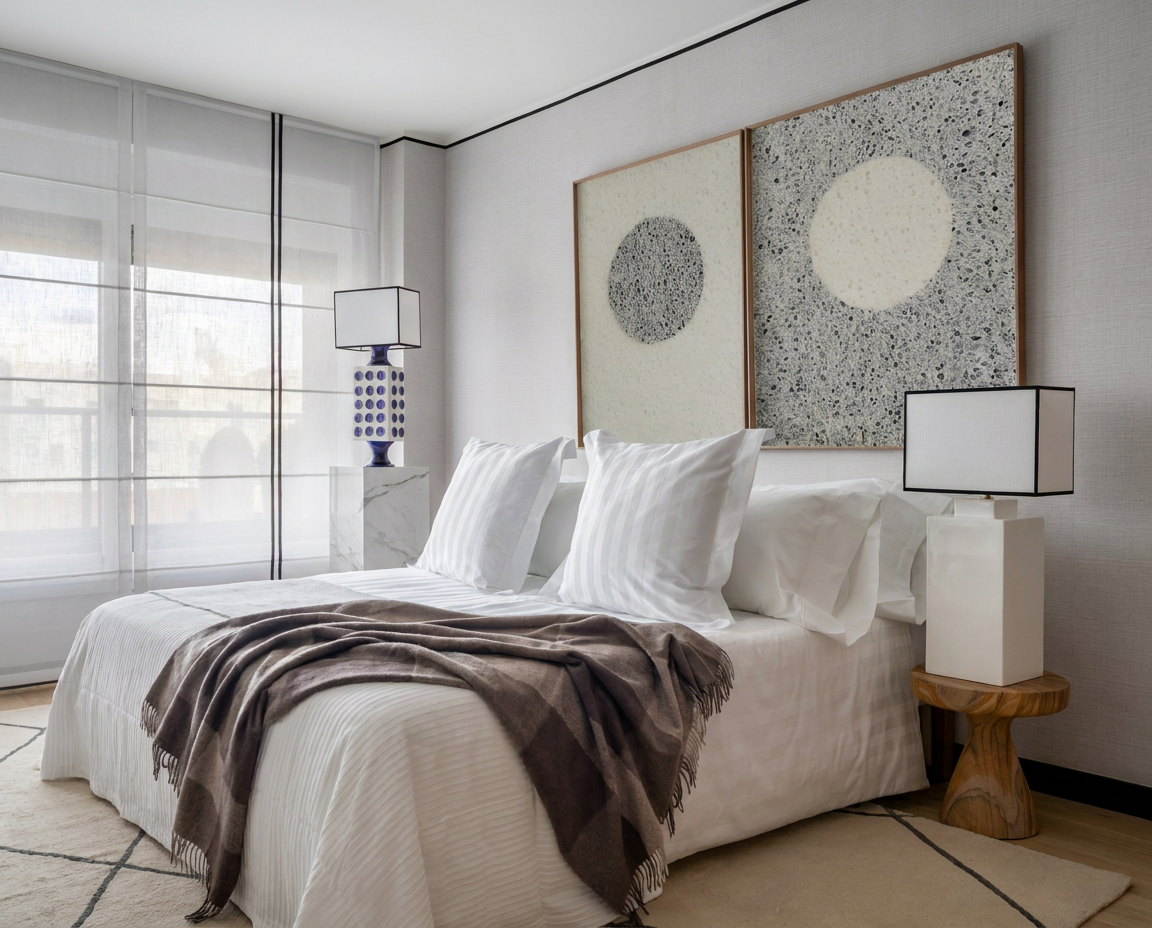
White, and Why It Still Wins
White remains the choice of households that understand home textiles, and not for want of imagination. Colour keeps the eye busy; white makes the fabric stand on its own merits: the weave, the sheen and the finish of the edge.
Percale is matt. It gives back a flat light and has a firm texture that feels slightly crisp at first, then softens wash after wash without losing its structure. Sateen has a continuous surface across which the afternoon light moves; it drapes more fluidly and is better at disguising light creases.
When colour is wanted, we can turn to finishing details such as a scalloped edge embroidered in colour.
The Layers, in Order
The first layer is not a sheet. It is the mattress protector, the piece nobody sees, which adds a few centimetres of height.
On top of it goes the bottom sheet, the piece that works hardest and the only one in contact with the body all night. Three things decide how it behaves: the composition of the fabric, the depth of the pocket and, on a fitted sheet, the strength of the elastic. A taut bottom sheet disappears; a loose one rucks up beneath the body, and those creases show through the top sheet.Then comes the top sheet, laid wrong side up. This is not a habit handed down without reason: when the turn-down is folded back over the blanket, the right side of the fabric ends up facing outwards, which is exactly where it should be.

The Turn-Down: Where a Bed’s Style Shows
The turn-down is the part of the top sheet that is folded back and stays on view. For generations it was where a household showed its craft: across those few centimetres the hemstitching was opened, the scalloped edge was finished and the initials that someone would one day inherit were embroidered.
Each finish produces a different edge and changes the visual weight of the bed. A scalloped edge closes with a firm, continuous finish; white on white, it is a relief that can only be appreciated up close, and that discretion is precisely its value. Hemstitching works the other way round: it opens a line of openwork in the fabric itself, lets the light through and ages better than any other finish . A pintuck adds a clean line through a stitched fold, without weighing down the edge. An embroidered band replaces the edge with a strip of openwork fabric that makes the turn-down the main feature of the room.
A bedroom with an upholstered headboard, curtains and a rug already has textiles to spare: there, a white scalloped edge is enough. A bed that is the only textile element in the room can carry a finish with more character.
Embroidered initials are the most timeless form of personalisation. The lettering and the side they go on (left or right, depending on where you enter the room) are also worth deciding before the embroidery begins.

Volume: Blanket, Duvet or Bedspread
This is where you decide not only the temperature, but also the silhouette of the bed.
A blanket has weight and drape, folds neatly under the turn-down and leaves the finish as the focal point. A duvet in its cover changes the profile, giving the bed more body. A bedspread tends to be used at times of year when temperatures are milder.
The Headboard
The proportions at the headboard are where most beds go wrong, almost always because too much has been piled on.
A pillowcase is chosen by the size of the pillow, never by the width of the bed: a 150 cm bed (a UK king size) can take one 150 cm pillow or two 70 cm ones, and they are not dressed in the same way. When it comes to arrangement, one rule always holds: restraint wins. Two 60 × 60 cm square pillows bring complete order to a headboard. Five cushions of different sizes turn it into a sofa.
The Linen Cupboard
A well-dressed bed is explained not by what lies on it, but by what is put away.
In homes where household linen is looked after, the cupboard is arranged in complete sets rather than single pieces. A bed linen set is made up as a whole, in the same quality and with the same finishing details, so that the bottom sheet, top sheet and pillowcase age in the same way over the years. When the pieces come from different places, the white of one stops being the white of the other, and the bed no longer reads as a set.
One last touch never goes unnoticed: ironing. An ironed top sheet has a drape that no sheet folded straight out of the tumble dryer can match, and the turn-down holds itself in place.